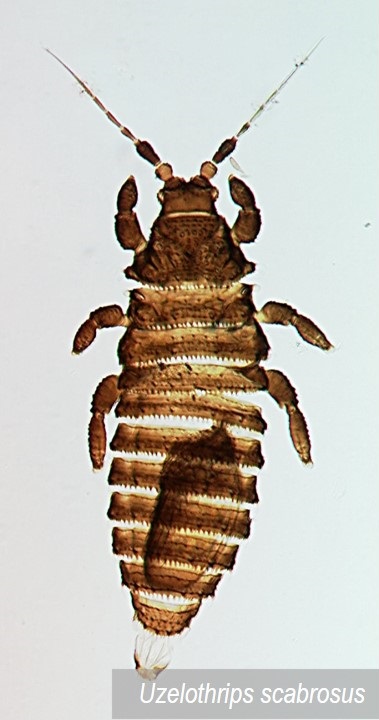
Uzelothripidae is known only from two species, the living Uzelothrips scabrosus, which was described from apterous males, and macropterous and apterous females collected in southern Brazil; and the fossil Uzelothrips eocenicus, known from Lower Eocene amber in France. Apparently originated from South America, U. scabrosus is also reported from Angola, Australia, Indonesia and Singapore. This species lives on dead twigs where it presumably feeds on fungi.
The structure of the antennae, abdomen and fore wing is so highly specialized that the relationships of this group remain conjectural. Adults of Uzelothrips are very small, usually wingless, and have the body surface strongly sculptured with a prominently lobed craspedum on the posterior margin of each tergite. They have a well-developed tentorium within the head and the fore wings bear setae with the cilia arising from sockets as in all Terebrantia. The antennae have only seven segments, with segment VII at least 30 times as long as wide, and segment III with a remarkable circular sensorium ventrally. The ovipositor is membranous and protrusible with no developed valves.
Click here to know more about Uzelothrips scabrosus.
References suggested:
Mound LA & Marullo R (1996) The Thrips of Central and South America: An Introduction. Memoirs on Entomology, International 6: 1–488.
Mound LA, Heming BS & Palmer JM (1980) Phylogenetic relationships between the families of recent Thysanoptera. Zoological Journal of the Linnean Society of London 69: 111–141.
Tree DJ (2009) Disjunct distribution of Uzelothripidae (Thysanoptera) new to Australia. Zootaxa 2009: 67–68.
Attendance
Brasil, Rio Grande do Sul, Rio Grande
Campus Carreiros: Av. Itália km 8
Bairro Carreiros
Thysanoptera © Todos Direitos Reservados 2026