With more than 2100 species distributed worldwide, this is the second largest family of Thysanoptera. Traditionally, four recognised subfamilies are recognised in this group: Dendrothripinae (105 spp.), Panchaetothripinae (140 spp.), Sericothripinae (170 spp.) and Thripinae (1715 spp.). Although most of these groups are supported by phylogenetic studies, the largest group, Thripinae, might be paraphyletic (Buckman et al. 2013).
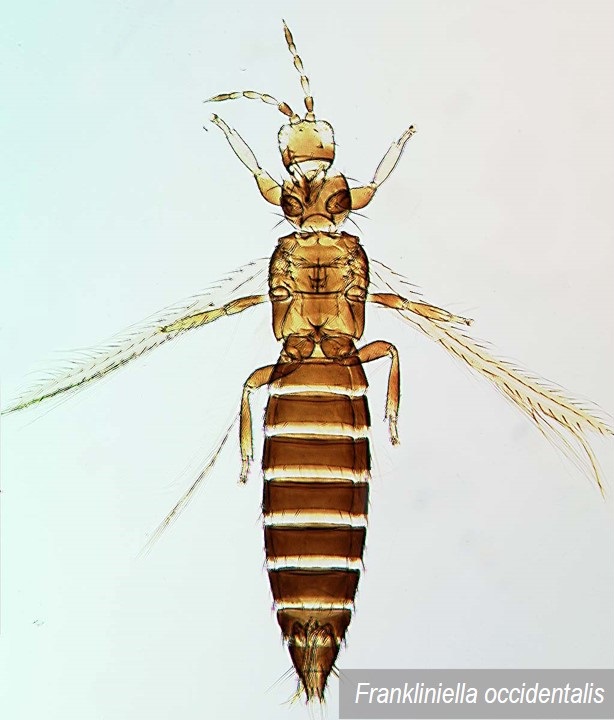
Thripines exhibit a wide range of biologies, with many breeding in flowers, but with others breeding on leaves, a large number associated only with grasses, a few feeding on mosses, and a very few obligate predators. Two of the most diverse and economically important genera belongs to this subfamily: Frankliniella and Thrips. The first is originated from the New World whereas the second is worldwide, except Neotropics. Frankliniella is a major group of flower-feeding thrips in Brazil, with more than 40 species recorded from this countryCavalleri & Mound (2012). Conversely, Panchaetothripines feed exclusively in leaves and some as Heliothrips haemorrhoidalis, Selenothrips rubrocinctus and Caliothrips spp. are considered pestiferous of several cultivated plants. Dendrothripines are minute thrips that also feed primarily on leaves, but with the exception of few species of Halmathrips and Leucothrips, they are not well represented in Brazil. The Sericothripinae can be found on flowers and leaves and the genus Neohydatothrips, is particularly diverse in Brazil, with more than 30 species recorded (Lima & Mound 2016).
The Thripidae are also very diverse in their external morphology. The plesiotypic number of nine antennal segments occurs in adults of several species, but adults of most species have only eight (e.g. Frankliniella) or seven antennal segments (e.g. Thrips), and some have even fewer. The antennal sensoria on segment III & IV are forked in adults of most species, one on each segment but simple sense cones are not uncommon. The posteromarginal cilia on the fore wing are wavy in most species of this family, and two longitudinal veins are usually visible.
References suggested:
Buckman RS, Mound LA & Whiting MF (2013) Phylogeny of thrips (Insecta: Thysanoptera) based on five molecular loci. Systematic Entomology 38: 123–133.
Cavalleri A & Mound LA (2013) Toward the identification of Frankliniella species in Brazil (Thysanoptera, Thripidae). Zootaxa 3270: 1–30.
Lima EFB & Mound LA (2016). Species-richness in Neotropical Sericothripinae (Thysanoptera: Thripidae). Zootaxa 4162(1): 1–45.
Mound LA & Marullo R (1996) The Thrips of Central and South America: An Introduction. Memoirs on Entomology, International 6: 1–488.

Attendance
Brasil, Rio Grande do Sul, Rio Grande
Campus Carreiros: Av. Itália km 8
Bairro Carreiros
Thysanoptera © Todos Direitos Reservados 2026