The Phlaeothripidae constitutes the largest family amongst the Thysanoptera, with approximately 3680 species in 450 genera distributed worldwide. Although representing a clearly monophyletic group, the Phlaeothripidae supra-generic classification is far from satisfactory; the genera are frequently ill-defined and the species concept usually is inadequately studied. Traditionally, the Phlaeothripidae are classified in two subfamilies: Idolothripinae and Phlaeothripinae.
The Idolothripinae comprises about 735 species and seems to represent a monophyletic group. Members of this subfamily have exceptionally broad maxillary stylets and feed by ingesting whole fungal spores. They are particularly abundant in the tropics, and about 70 species of Idolothripinae are recorded from Brazil. Most species are found on dead leaves or twigs, and some genera such as Elaphrothrips and Anactinothrips are particularly abundant and diverse in Brazil. Some species of Allothrips live in leaf litter whereas Compsothrips species are associated with the bases of grasses in south Brazil.
The Phlaeothripinae, in contrast, is a much larger group, with about 2900 species in 360 genera, and according to recent phylogenetic studies this subfamily is presumably paraphyletic. There are about 300 species of Phlaeothripinae recorded from Brazil, most of them described by Dudley Moulton or J. D. Hood in the last century. These thrips are very diverse in their feeding-behaviour, but most of the Brazilian species possibly feed on plant leaves, sometimes inducing galls or malformations (e.g. Holopothrips, Liothrips). Others, such as Haplothrips species, are associated primarily with flowers, and a few feed on mosses (e.g. Williamsiella). Phlaeothripines are particularly diverse in leaf-litter, where they feed on fungal hyphae, and some are known to be predators on small arthropods (e.g. Karnyothrips and Leptothrips)
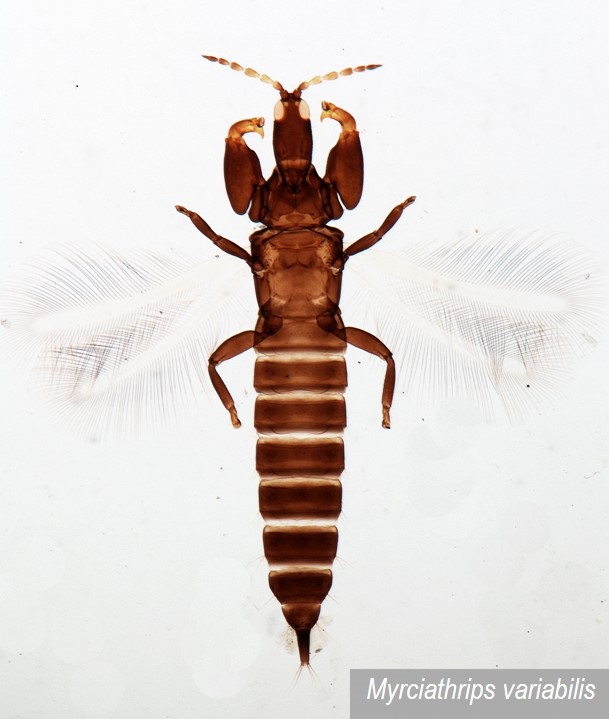
All Phlaeothripidae have abdominal segment X forming an enclosed tube and wings, when present, lack longitudinal veins or veinal setae. Adults of the great majority of species have eight antennal segments, reduction to seven or even less is uncommon, and no species has nine segments. They usually have more than one emergent and simple sense cones on antennal segments three and four. Females lack an external ovipositor and the eggs are deposited on the substrate.
Click here to see the species recorded from Brazil.
References suggested:
Buckman RS, Mound LA & Whiting MF (2013) Phylogeny of thrips (Insecta: Thysanoptera) based on five molecular loci. Systematic Entomology 38: 123–133.
Cavalleri A, De Souza AR, Prezoto F & Mound LA (2013) Egg predation within the nests of social wasps: a new genus and species of Phlaeothripidae, and evolutionary consequences of Thysanoptera invasive behaviour. Biological Journal of the Linnean Society 109: 332–341.
Mound LA & Palmer JM (1983) The generic and tribal classification of spore-feeding Thysanoptera (Phlaeothripidae: Idolothripinae). Bulletin of the British Museum (Natural History). Entomology 46: 1–174.
Mound LA & Marullo R (1996) The Thrips of Central and South America: An Introduction. Memoirs on Entomology, International 6: 1–488.

Attendance
Brasil, Rio Grande do Sul, Rio Grande
Campus Carreiros: Av. Itália km 8
Bairro Carreiros
Thysanoptera © Todos Direitos Reservados 2026