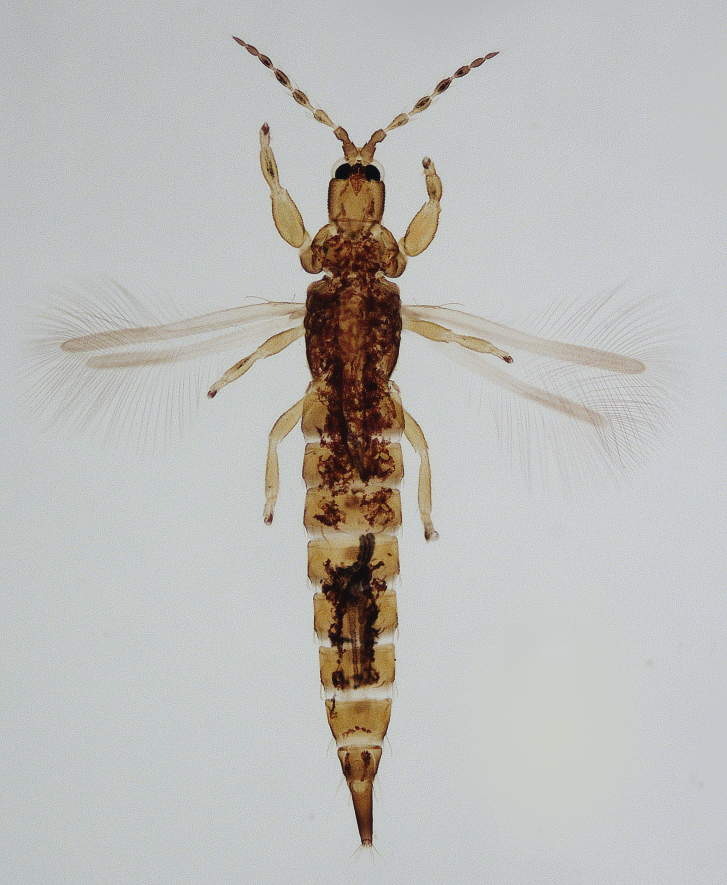
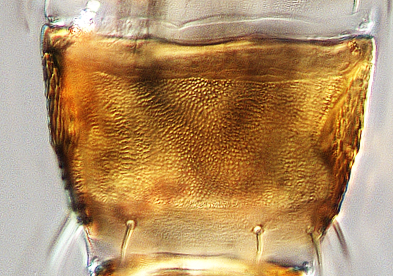
Glyptothrips hylaeus (Hood, 1950: 111).
Original reference: Hood JD (1950) Brasilian Thysanoptera II. Revista de Entomologia 21: 1–113.
Family
Phlaeothripidae, Phlaeothripinae
Nomenclatural information
http://thrips.info/wiki/Glyptothrips_hylaeus
Diagnosis
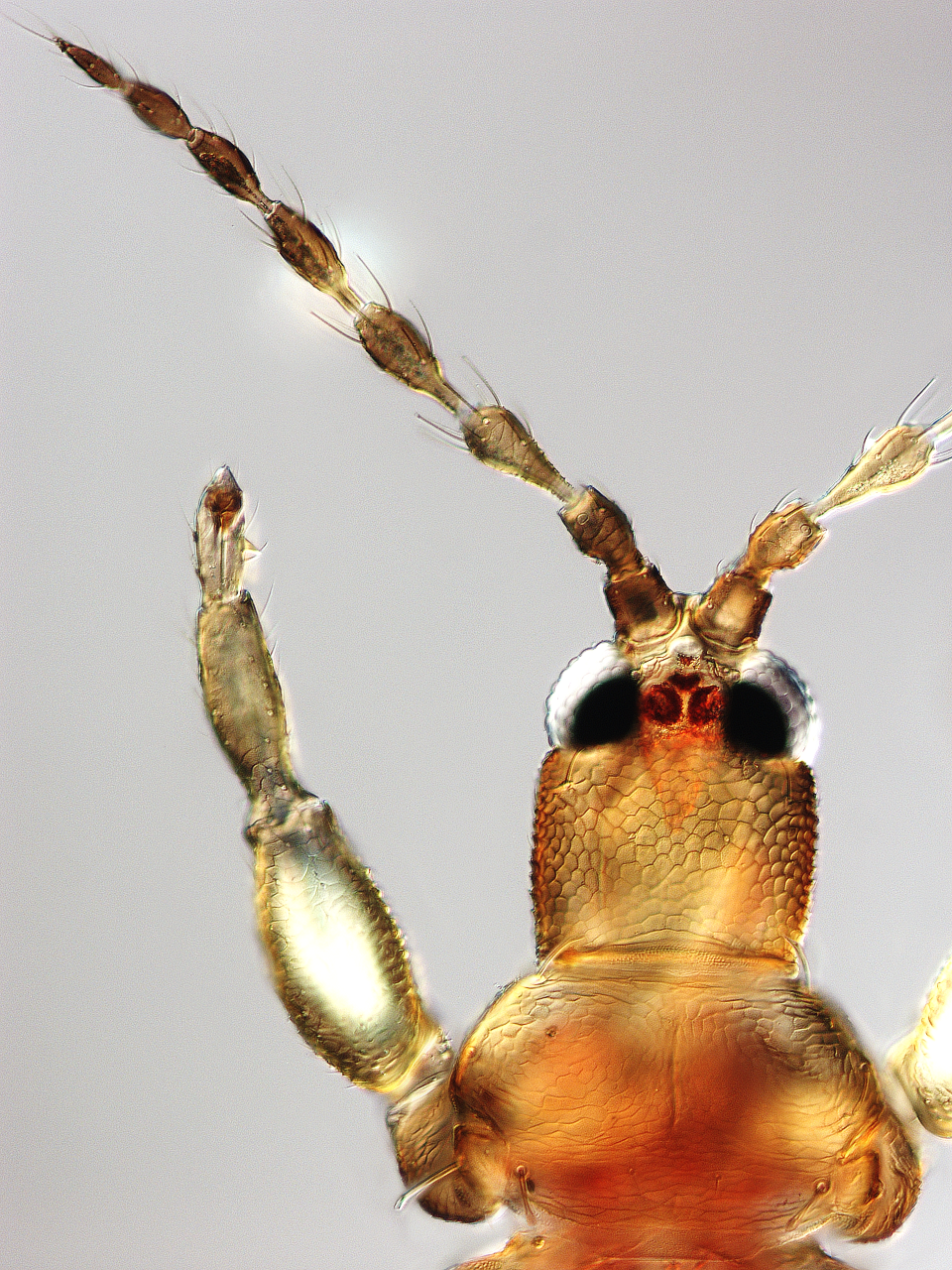
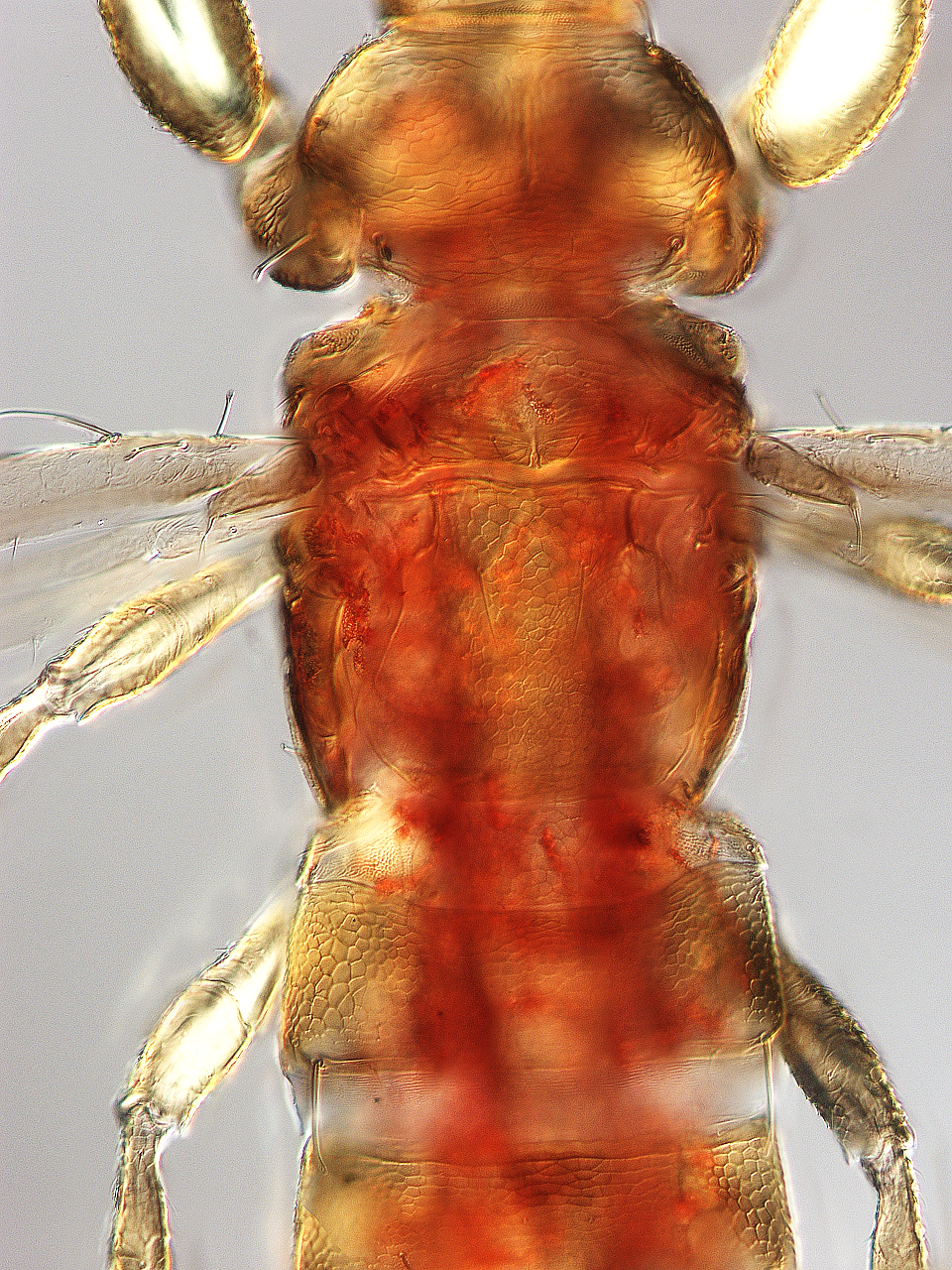
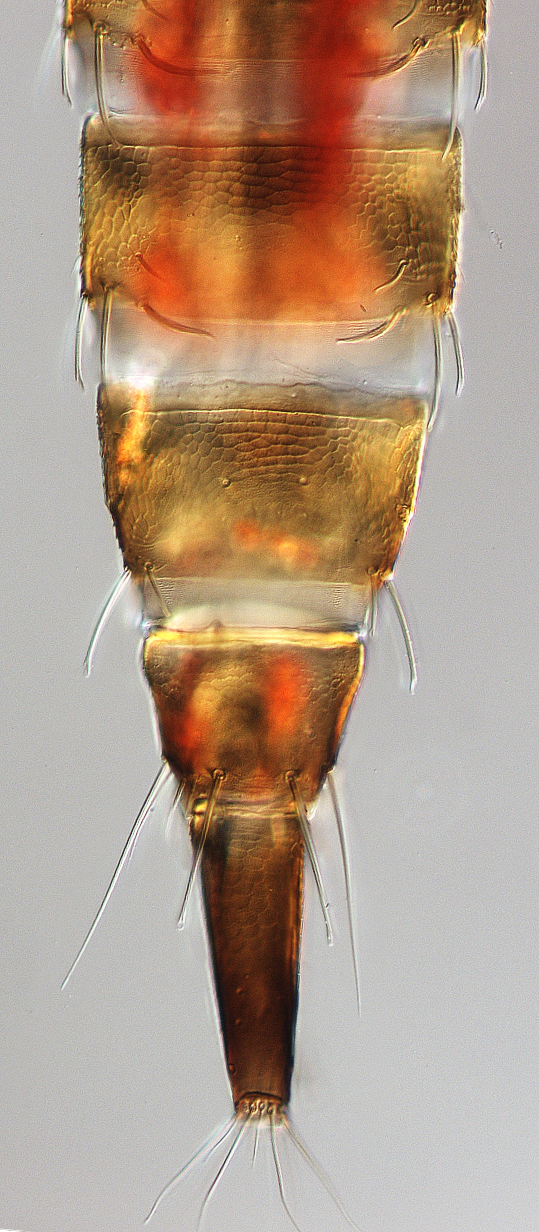
Male macropterous; body color mainly yellow, with sides of head, pterothorax and abdominal segments IX and X brown; abdominal segments III–VIII with a brown spot anteromedially; antennomeres I–II brown, III yellow but shaded brown apically, IV–VI brown with yellow pedicel, VII–VIII brown; wings yellowish, with bases and apexes shaded with brown. Antennae 8-segmented, basal antennomeres with stout and capitate setae; III with 3 and IV with 4 sense cones. Head strongly reticulated, about 1.3 times as long as the greatest width; postocular setae much shorter than the length of the eye; lateral margins straight and constricted behind globose eyes; maxillary stylets wide apart. Pronotum reticulated, with 4 pairs of well-developed and capitate setae, anteromarginal pair reduced or absent; prosternal basantra present. Meso- and metanotum strongly reticulated. Pterothorax with a pair of stout and capitate ventrolateral setae on each segment. Pelta broad and reticulated; abdomen strongly sculptured, tergites II–VII with 2 pairs of wing-retaining setae. Abdominal sternite VIII with a large pore plate, covering almost the entire sternite. Tube cone-shaped, weakly reticulated only at base and without lateral setae, about 2.5x as long as basal width. Fore legs slightly thicker than the other legs, tibiae without tubercles, fore tarsi with a tooth. Fore wings without duplicated cilia.
Female not studied.
Intraspecific variation
Unknown.
Genus and similar species information
Glyptothrips is a genus with 14 valid species, with an apparently disjunct distribution between North and South America. The members of this genus have a strongly sculptured body, but tube usually smooth; head incut behind small, globose but well-developed eyes; postocular and main pronotal setae (except anteromarginal pair) well-developed and with capitate apex; and most species bear strong and capitate setae on basal antennomeres and/or ventrolateral region of pterothorax. Glyptothrips hylaeus is very similar to G. saltuarius, both in coloration and structure; but the former has a relatively shorter head than the latter. A key to the Brazilian Glyptothrips species is available in Lindner et al. (2023).
Distribution around the world
Described from São Paulo, Brazil.
Distribution in Brazil
http://fauna.jbrj.gov.br/fauna/faunadobrasil/37395
Life history
Lives in leaf-litter, where it possibly feeds on fungal hyphae.
Economic importance
Not recorded.
Suggested references
Hood JD (1950) Brasilian Thysanoptera II. Revista de Entomologia 21: 1–113.
Mound LA (1977) Species diversity and the systematics of some New World leaf-litter Thysanoptera (Phlaeothripinae; Glyptothripini). Systematic Entomology 2: 225-244. DOI: https://doi.org/10.1111/j.1365-3113.1977.tb00371.x
Lindner MF, Ferrari A, Lima EFB & Cavalleri A (2023) Morphological identification of Glyptothrips species (Thysanoptera: Phlaeothripidae). Zootaxa 5375 (1): 031–057. DOI: https://doi.org/10.11646/zootaxa.5375.1.2
Attendance
Brasil, Rio Grande do Sul, Rio Grande
Campus Carreiros: Av. Itália km 8
Bairro Carreiros
Thysanoptera © Todos Direitos Reservados 2026