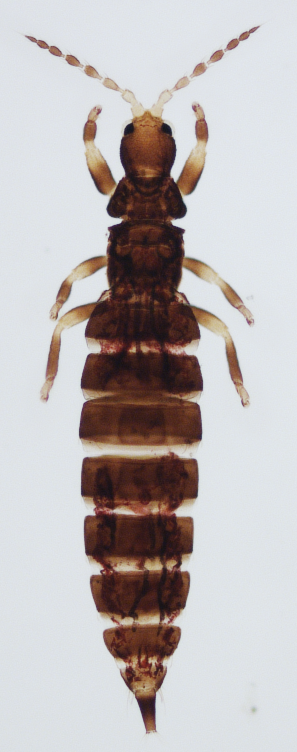
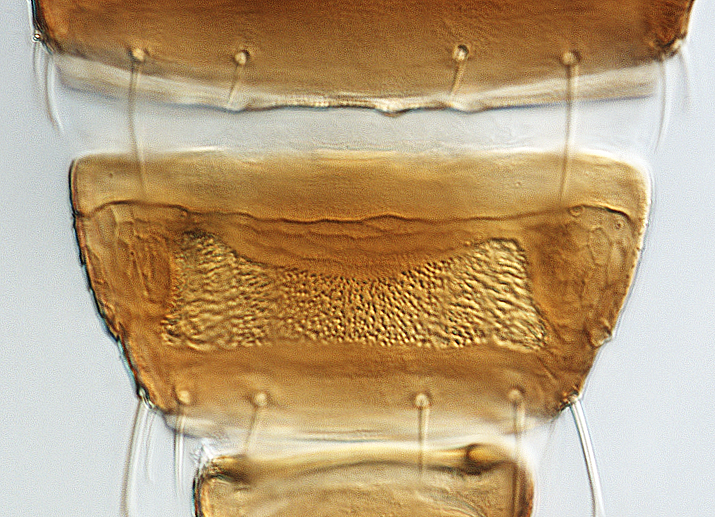
Glyptothrips subcalvus (Hood, 1954: 33).
Original reference: Hood JD (1954) Brazilian Thysanoptera IV. Proceedings of the Biological Society of Washington 67: 17–54.
Family
Phlaeothripidae, Phlaeothripinae
Nomenclatural information
http://thrips.info/wiki/Glyptothrips_subcalvus
Diagnosis
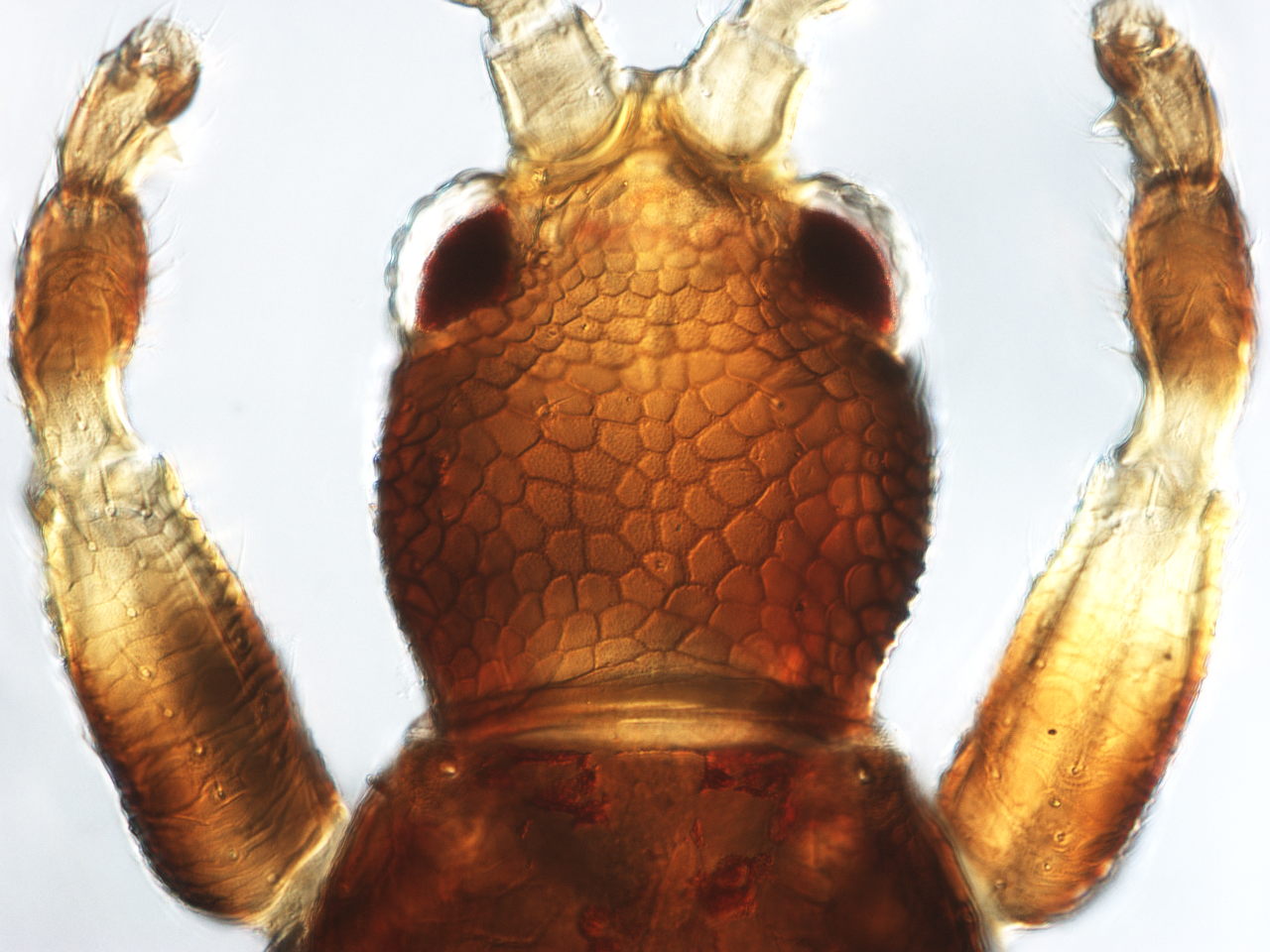
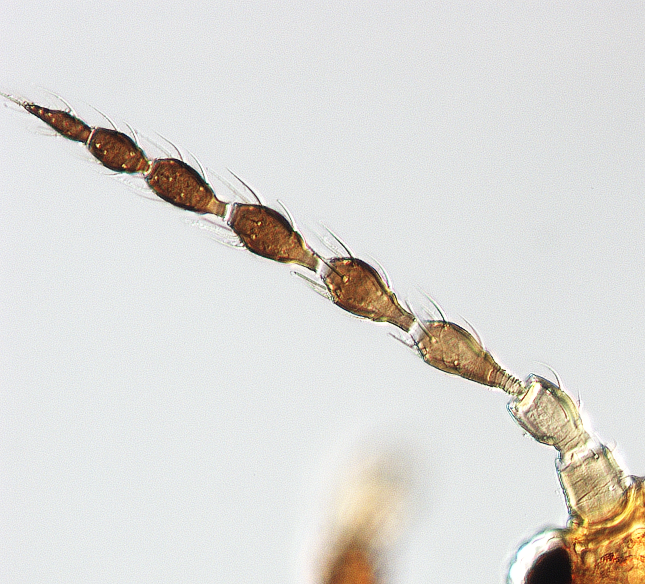
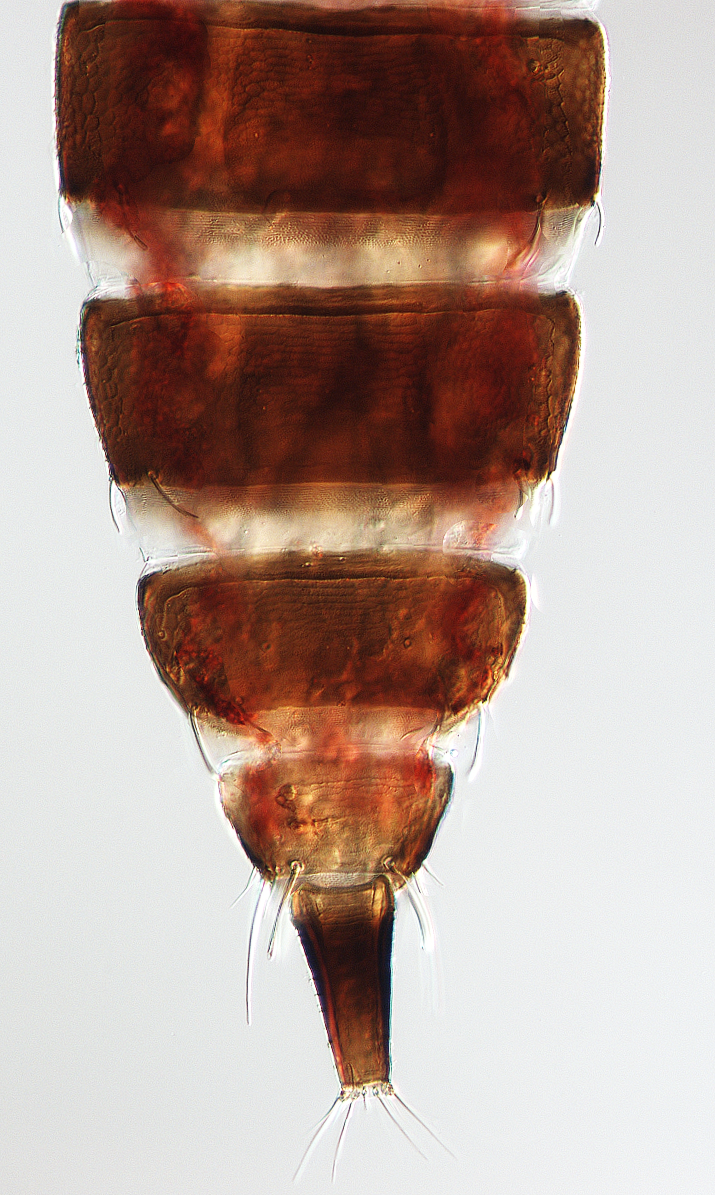
Female micropterous or apterous; body color mainly brown, with the apex of head, abdominal segment IX and apex of tube lighter; legs mainly brown, with coxae, knees and tarsi yellow; antennomeres I–II light yellow, III yellow to light brown, IV brown with lighter base, V–VI brown with yellow pedicel, VII–VIII brown. Antennae 8-segmented, basal antennomeres with stout and capitate setae; III and IV with 2 sense cones each. Head strongly reticulated, about 1.1 times as long as the greatest width; postocular setae much shorter than the length of the eye; lateral margins curved and constricted behind globose eyes; maxillary stylets wide apart. Pronotum reticulated, with 4 pairs of well-developed and capitate setae, anteromarginal pair reduced or absent; prosternal basantra present. Meso- and metanotum strongly reticulated. Pterothorax with a pair of stout and capitate ventrolateral setae on each segment. Pelta broad, almost rectangular, transversely striate; abdomen strongly sculptured, tergites II–VII without wing-retaining setae. Tube cone-shaped, weakly reticulated only at base and without lateral setae, about 2x as long as basal width. All legs similar in appearance, fore femora with long and capitate setae in some specimens, tibiae without tubercles, fore tarsi with a tooth. Fore wings without duplicated cilia.
Male micropterous or apterous. Similar to female, except for having setae S2 of abdominal tergite IX shorter. Pore plate present on abdominal sternite VIII, a transverse band medially; but reduced in some specimens.
Intraspecific variation
Micropterous and apterous forms are known for this species. Males show variation in the pore plate size, from a large plate covering almost the entire sternite to a plate reduced to two small lateral triangles.
Genus and similar species information
Glyptothrips is a genus with 14 valid species, with an apparently disjunct distribution between North and South America. The members of this genus have a strongly sculptured body, but tube usually smooth; head incut behind small, globose but well-developed eyes; postocular and main pronotal setae (except anteromarginal pair) well-developed and with capitate apex; and most species bear strong and capitate setae on basal antennomeres and/or ventrolateral region of pterothorax. Glyptothrips subcalvus has a unique color pattern within the brazilian species of Glyptothrips, with the body mainly dark brown, but legs with a pattern of light and dark bands, and antennomeres I and II pale yellow, contrasting with the head. It also has only two sense cones on antennomere IV. A key to the Brazilian Glyptothrips species is available in Lindner et al. (2023).
Distribution around the world
Described from Santa Catarina, Brazil.
Distribution in Brazil
http://fauna.jbrj.gov.br/fauna/faunadobrasil/89146
Life history
Lives in leaf-litter, where it possibly feeds on fungal hyphae.
Economic importance
Not recorded.
Suggested references
Mound LA (1977) Species diversity and the systematics of some New World leaf-litter Thysanoptera (Phlaeothripinae; Glyptothripini). Systematic Entomology 2: 225-244. DOI: https://doi.org/10.1111/j.1365-3113.1977.tb00371.x
Lindner MF, Ferrari A, Lima EFB & Cavalleri A (2023) Morphological identification of Glyptothrips species (Thysanoptera: Phlaeothripidae). Zootaxa 5375 (1): 031–057. DOI: https://doi.org/10.11646/zootaxa.5375.1.2
Attendance
Brasil, Rio Grande do Sul, Rio Grande
Campus Carreiros: Av. Itália km 8
Bairro Carreiros
Thysanoptera © Todos Direitos Reservados 2026