Myrciathrips variabilis Cavalleri, Lindner & Mendonca, 2016: 1407.
Original reference: Cavalleri, A, Lindner, MF & Mendonça Jr, M de S (2016) New Neotropical Haplothripini (Thysanoptera: Phlaeothripidae) with a key to Central and South American genera. Journal of Natural History 50: 1389–1410. doi: https://doi.org/10.1080/00222933.2015.1113316
Family
Phlaeothripidae, Phlaeothripinae
Nomenclatural information
https://thrips.info/wiki/Myrciathrips_variabilis
Diagnosis
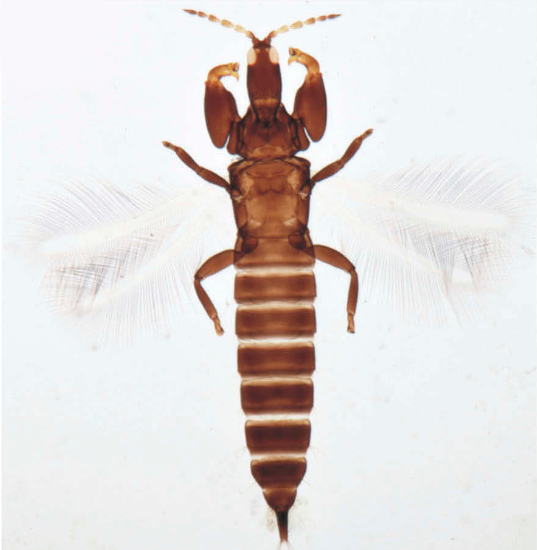
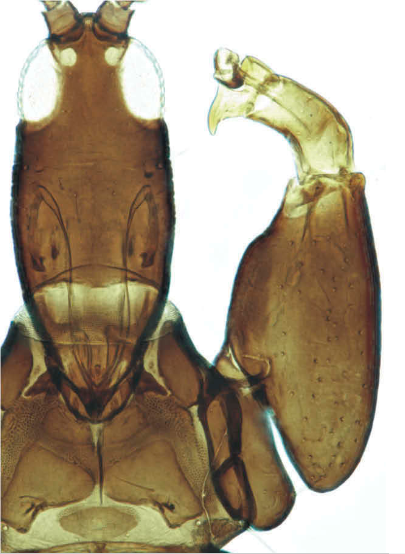
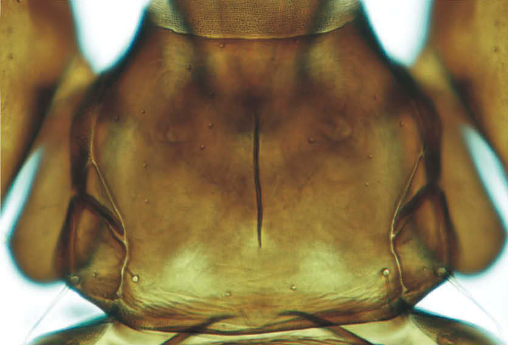
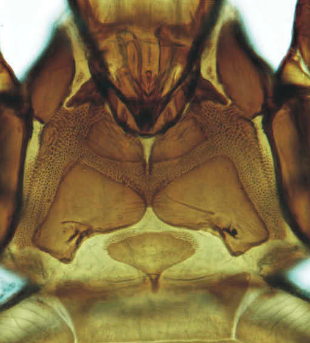
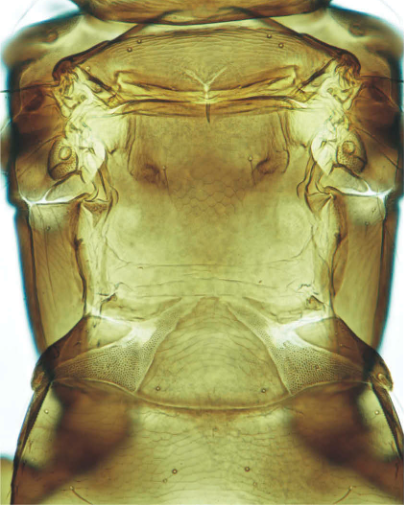
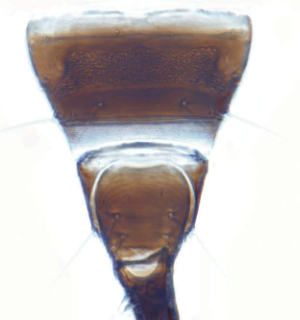
Female macropterous; body color brown, with fore tibiae and all tarsi yellow; antennomere I brown, II brown with yellowish apex, III–IV yellow, V–VI yellow with apex shaded brown, VII–VIII brown; wings clear and without a median dark line. Antennae 8-segmented, antennomere III with 2 and IV with 4 sense cones. Head about 1.7x as long as greatest width, dorsal surface smooth; postocular setae shorter than the eye and capitate, close to the slightly curved lateral margins; maxillary stylets retracted to the base of postocular setae, about 1/3 of head width apart, with a maxillary bridge. Pronotum trapezoidal, with a dark median longitudinal line; epimeral and posteroangular setae well developed, remaining setae small and thin; prosternal basantra present. Metanotum reticulated anteromedially, with a pair of long and pointed setae medially. Pelta triangular, reticulated anteromedially, with a pair of campaniform sensilla; abdomen sculptured, tergites II–VII with 2 pairs of wing-retaining setae. Tube cone-shaped, about 2.3x as long as basal width, without lateral setae. Fore legs greatly enlarged, fore femora shorter than the rest, fore tarsi with well-developed hamus and tarsal tooth. Fore wings constricted medially, with 9–13 duplicated cilia.
Male macropterous. Similar to female but smaller, with prothorax and fore legs not as swollen as in females. Pore plate present, transverse, covering a good part of abdominal sternite VIII.
Intraspecific variation
Some specimens, especially females, may have a third pair of wing-retaining setae in some abdominal tergites.
Genus and similar species information
Myrciathrips is a monotypic genus, belonging to tribe Haplothripini. It shares with members of the tribe the medially constrict fore wings, presence of a bridge linking the maxillary stylets, and a well-developed basantra; but it is distinguished from other genera in this group by the females bearing greatly swollen fore legs, without tubercles, but with both the hamus and tarsal tooth well developed. Besides that, both sexes have an elongated head, only two pairs of long pronotal setae, and basal setae on fore wings shorter than the width of the wing.
Distribution around the world
Described from Brazil.
Distribution in Brazil
http://fauna.jbrj.gov.br/fauna/faunadobrasil/189392
Life history
Phytophagous species, which breeds inside leaf-galls of Myrcia guianensis induced by Holopothrips molzi.
Economic importance
Not recorded.
Suggested references
Cavalleri, A, Lindner, MF & Mendonça Jr, M de S (2016) New Neotropical Haplothripini (Thysanoptera: Phlaeothripidae) with a key to Central and South American genera. Journal of Natural History 50: 1389–1410. doi: https://doi.org/10.1080/00222933.2015.1113316
Lindner, MF, Mendonça Jr, M de S & Cavalleri, A (2016) Holopothrips molzi sp.n. (Thysanoptera, Phlaeothripidae): natural history and interactions in Myrtaceae galls. Zootaxa 4114 (2): 139–148. doi: http://doi.org/10.11646/zootaxa.4114.2.3
Attendance
Brasil, Rio Grande do Sul, Rio Grande
Campus Carreiros: Av. Itália km 8
Bairro Carreiros
Thysanoptera © Todos Direitos Reservados 2026