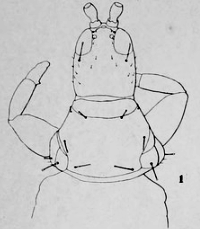
Dolichothrips indicus (Hood, 1919: 96).
Original reference: Hood JD (1919) On some new Thysanoptera from southern India. Insecutor inscitiae menstruus 7: 90–103.
Family
Phlaeothripidae, Phlaeothripinae
Nomenclatural information
https://thrips.info/wiki/Dolichothrips_indicus
Diagnosis
Female macropterous; body color dark brown, with all tarsi, most of fore tibiae and tip of mid and hind tibiae yellow; antennomeres I and VIII brown, II brown with yellow apex, III–VI yellow, VII yellow with brown apex; wings hyaline. Antennae 8-segmented, antennomere III with 3 and IV with 4 sense cones. Head longer than wide, with lateral margins slightly curved and weakly constricted basally; dorsal and lateral surfaces weakly sculptured, with a few short and thin setae; eyes well-developed, postocular setae shorter than the eyes, with weakly dilated tips; maxillary stylets retracted to postocular setae, V-shaped, with a maxillary bridge; mouth cone long and pointed, extending between fore coxae. Pronotum without sculpture, notopleural sutures complete, with 5 pairs of well-developed and capitate setae, prosternal basantra present. Mesonotum with short and thin lateral setae.Metanotum with a triangular sculptured area medially: longitudinally striated on the sides, weakly reticulated medially; with one pair of well-developed median setae, distanced from each other. Metathoracic sternopleural sutures absent. Pelta triangular to arcuate, with irregular margins, weakly reticulated only medially. Abdominal tergites with weak transverse striae anteriorly and laterally, tergites II–VII with 2 pairs of wing-retaining setae, at times bearing multiple lateral accessory setae, short and straight. Tube with slightly convex lateral margins without setae, almost 2x as long as basal width, terminal setae slightly longer than the tube. All legs similar in appearance, fore tarsi with a short and stout tooth. Fore wings constricted medially, with 6–7 duplicated cilia.
Male macropterous. Similar to female except for having a larger tarsal tooth, and the anterior setae on pronotum are sometimes shorter. Pore plates absent.
Intraspecific variation
The shape of the apex of postocular setae is variable, from finely pointed to blunt, and even slightly dilated. The apex of mid and hind tibiae varies from only slightly paler than the rest of the tibiae to yellow, and this paler area may have different sizes between specimens. The abdominal tergites may bear accessory setae besides the two pairs of wing-retaining setae, and the presence of the former may be associated with larger specimens.
Genus and similar species information
Dolichothrips is a genus widely-distributed across Asia and the Pacific Islands, with around 20 valid species. Most of these species are associated with flowers and leaves of a variety of plants, and some of them are pollinators of Macaranga species (Euphorbiaceae). Dolichothrips is included within tribe Haplothripini, sharing with other members of this tribe characters like antennomere IV with 4 sense cones, maxillary stylets linked by a bridge, pronotum with complete notopleural sutures, forewings constricted medially, and males without pore plates. Dolichothrips indicus is the only species of this genus recorded from Brazil. A key to part of the Dolichothrips species is available in Mound & Okajima (2015).
Distribution around the world
Described from India. Widely distributed across east and southeast Asia, and several Pacific Islands. Recorded from the Americas in Barbados and Brazil.
Distribution in Brazil
Amazonas (FURG Collection) and Maranhão (Mound & Okajima 2015).
Life history
This species is associated with flowers of a variety of plants, where it probably feeds and reproduces.
Economic importance
Not recorded.
Suggested references
Hood JD (1919) On some new Thysanoptera from southern India. Insecutor inscitiae menstruus 7: 90–103.
Mound LA & Minaei K (2007) Australian insects of the Haplothrips lineage (Thysanoptera – Phlaeothripinae). Journal of Natural History 41: 2919-2978. DOI: https://doi.org/10.1080/00222930701783219
Dang LH, Mound LA & Qiao GX (2014) Conspectus of the Phlaeothripinae genera from China and Southeast Asia (Thysanoptera, Phlaeothripidae). Zootaxa 3807: 001-082. DOI: https://doi.org/10.11646/zootaxa.3807.1
Mound LA & Okajima S (2015) Taxonomic Studies on Dolichothrips (Thysanoptera: Phlaeothripinae), pollinators of Macaranga trees in Southeast Asia (Euphorbiaceae). Zootaxa 3956 (1): 79-96. DOI: https://doi.org/10.11646/zootaxa.3956.1.4
Attendance
Brasil, Rio Grande do Sul, Rio Grande
Campus Carreiros: Av. Itália km 8
Bairro Carreiros
Thysanoptera © Todos Direitos Reservados 2026